
Buying Tortuga was one decision. Rebuilding her would turn out to be hundreds of them.
We knew we were buying a project. We had noticed damage during the initial inspection, and we understood that there would be work ahead. We weren’t expecting a boat that needed nothing more than a wash and a fresh coat of paint.
But knowing there are problems and beginning to understand what is behind them are two different things.
Then we found termites.
That felt like a punch in the gut.
The discovery put the damage we had already noticed in a different light. Now there were more questions to answer about what we were dealing with and how much work it would take. The boat I could imagine my family enjoying was still there, but so was a reality that was becoming harder to look past.
I had wanted to rebuild a boat. That didn’t mean I was prepared for every part of rebuilding this one.
How bad was it?
Once Fabian and I realized we had a problem, the next question was how much of a problem we had.
Was it a square meter of damaged wood? Was it something we could isolate, remove, and repair without taking much else apart? Before we could decide what to do, we needed to define the problem.
So we started looking.
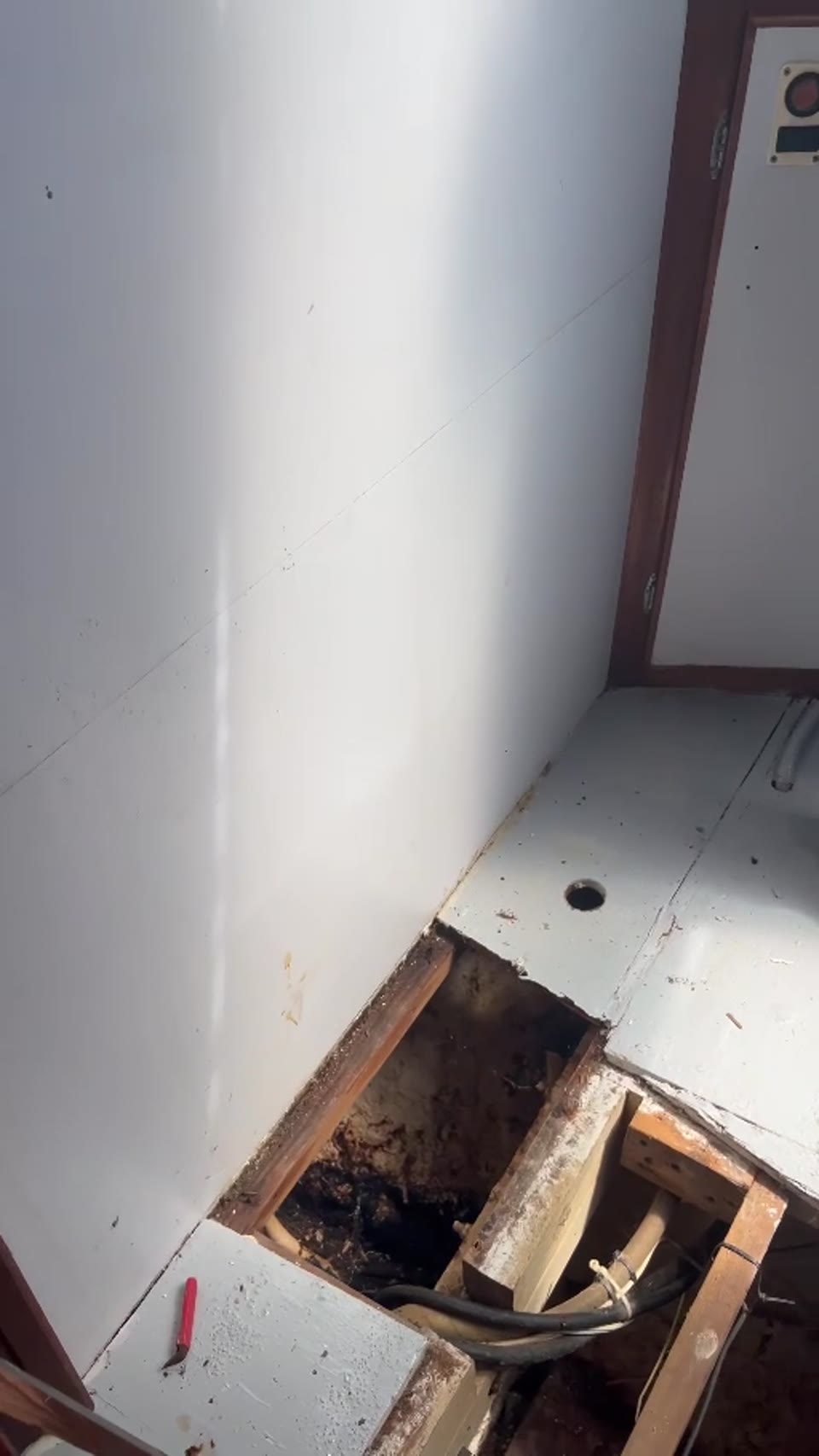
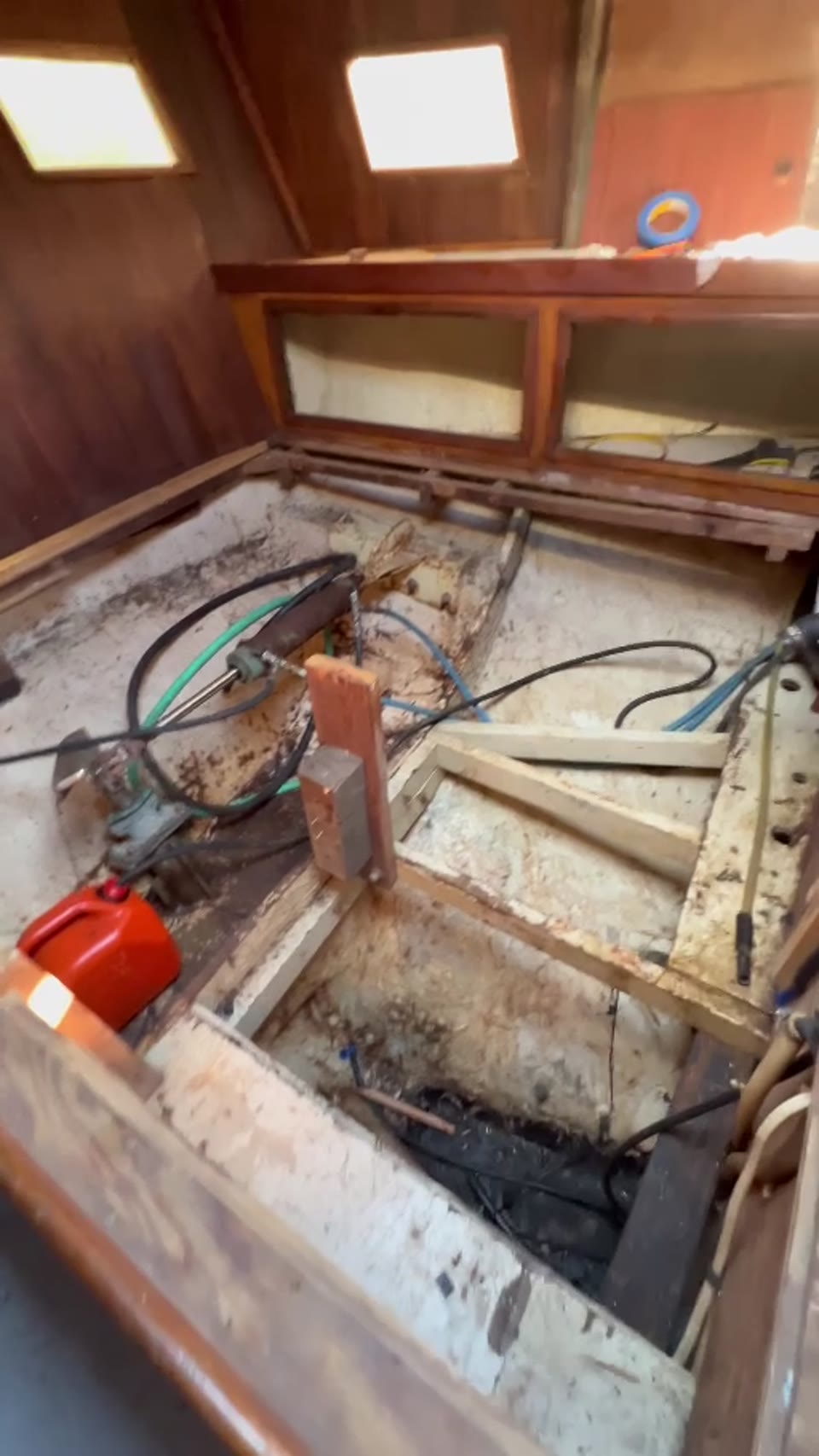
The entire aft captain’s quarters was rotten.
There was termite damage in the aft head, the boat’s bathroom. In the battery room, the shelves and the other wood were rotten too. We kept moving forward, trying to find where the damage stopped.
As we went, the reality of the job was sinking in. We weren’t finding one small area that explained everything. We were finding more work each time we looked somewhere else.
In the midship area, the starboard saloon was all rot. The port-side saloon was mostly rotten. The galley cabinets and counters had rot and termite damage. The mid cabin across from the galley was rotten as well.
That was where the rot ended.
By the time we had a good grasp of the extent, roughly two-thirds of the interior needed to be rebuilt. We would have to remove all of that damaged wood.
To me, it felt like twenty times the work we had planned. That wasn’t an estimate worked out on a spreadsheet. It was how far the reality had moved beyond the project I thought we were taking on.
Most of the wood we were removing was pine from the original build. It had been there for about forty years. The problems were not all the same. Some of the damage was from termites. Some was wood rot from fresh water leaking through the deck and seeping into the boat.
The age of the wood was part of the history, but it wasn’t the whole explanation. There had been water intrusion, termites, and years of neglect. What we were looking at was the result of those problems being allowed to continue.
We now had a much clearer understanding of what needed to come out.
Understanding it did not make it easier to take in.
What my family could see
I remember going home that day feeling defeated.
The situation seemed hopeless. I had to tell my wife and kids how extensive the damage was, and how much larger the rebuild had become. This was supposed to be a project that would lead to experiences we could share as a family. That day, what I brought home was news of more damage and far more work.
My wife and kids were supportive. They kept telling me they had faith in me, that they believed I could rebuild her.
They also saw something I was struggling to appreciate at the time. It was better to find these problems now, while Tortuga was on dry land, than after we were afloat.
We could deal with the damage in the yard. We weren’t already at sea, wondering what an unseen problem might mean for us, or facing the prospect of having to get the boat back out of the water to open everything up again.
Ultimately, they were right.
That didn’t mean the damage was less extensive than I had thought. It meant we had discovered it while we had the chance to do something about it. They were looking at the same situation and seeing the value of knowing, rather than only the weight of what we had learned.
I needed to accept the reality of the boat in front of me.
There was no point in staying upset as though that would change her condition. Tortuga didn’t care how blue I felt. She was sick, and she needed attention. That was how I thought about it: she had a cancer that needed to be removed so we could begin healing her.
I had two choices. I could stop there and abandon the project, or I could see it through and rebuild her properly.
I chose to keep going.
Part of that decision was the kind of rebuild I wanted to give her. I wanted to use teak, with the hope that the new work would last for much of a lifetime. That was the ambition, not something we had already accomplished. The damaged wood still had to come out, and the materials for its replacement still had to be found.
The choice was clear. The practical answers were not all there yet.
What kept me going
Stubbornness, maybe.
That is at least part of the honest answer. I had set myself a goal, and I wanted to finish what I had started. But it wasn’t only about finishing a project. It was about what I hoped that project would make possible.
I could still picture my family enjoying Tortuga together.
Maybe we would take her down to the Galápagos. Maybe we would see Patagonia and make a passage through the Strait of Magellan. Those weren’t promises or a fixed itinerary. They were possibilities I wanted us to have.
When I thought about the boat, I wasn’t only thinking about the work in front of me. I was thinking about the experiences we might share because we had done that work.
The dream was stronger than my current reality.
That didn’t make the reality disappear. Wanting this badly wasn’t going to repair the damage. We still had to understand the problems, make decisions, and do the work.
But it gave me a reason to keep going.
Taking Her Apart on Faith
Once I had decided to keep going, Fabian and I had to work out how to take Tortuga apart without losing the things we wanted to keep.
The wood was damaged. That didn’t mean every idea behind the interior was bad.
Her layout was functional. It had served the boat for forty years, and there were parts of it that made sense to preserve. We didn’t need to change everything simply because we were rebuilding. I wanted to keep some of the form of her past while giving her a fresh start.
Another forty years. That was what I hoped we could give her.
But before we could remove the damaged interior, we needed to document what was there.
Every drawer. Every cabinet. Every shelf. Every bunk. Every step.
Once those things came out, we couldn’t depend on memory to put the useful parts of the layout back together. We needed a record of what we were dismantling, something we could return to when it was time to build again.
That documentation was part of the work, even though it wasn’t the part that would make Tortuga look any better. Before we could begin giving her a new interior, we had to pay attention to the old one.
There was a difference between removing damaged wood and throwing away everything that had worked. We were trying to understand that difference as we went.
Then we started disassembling her.
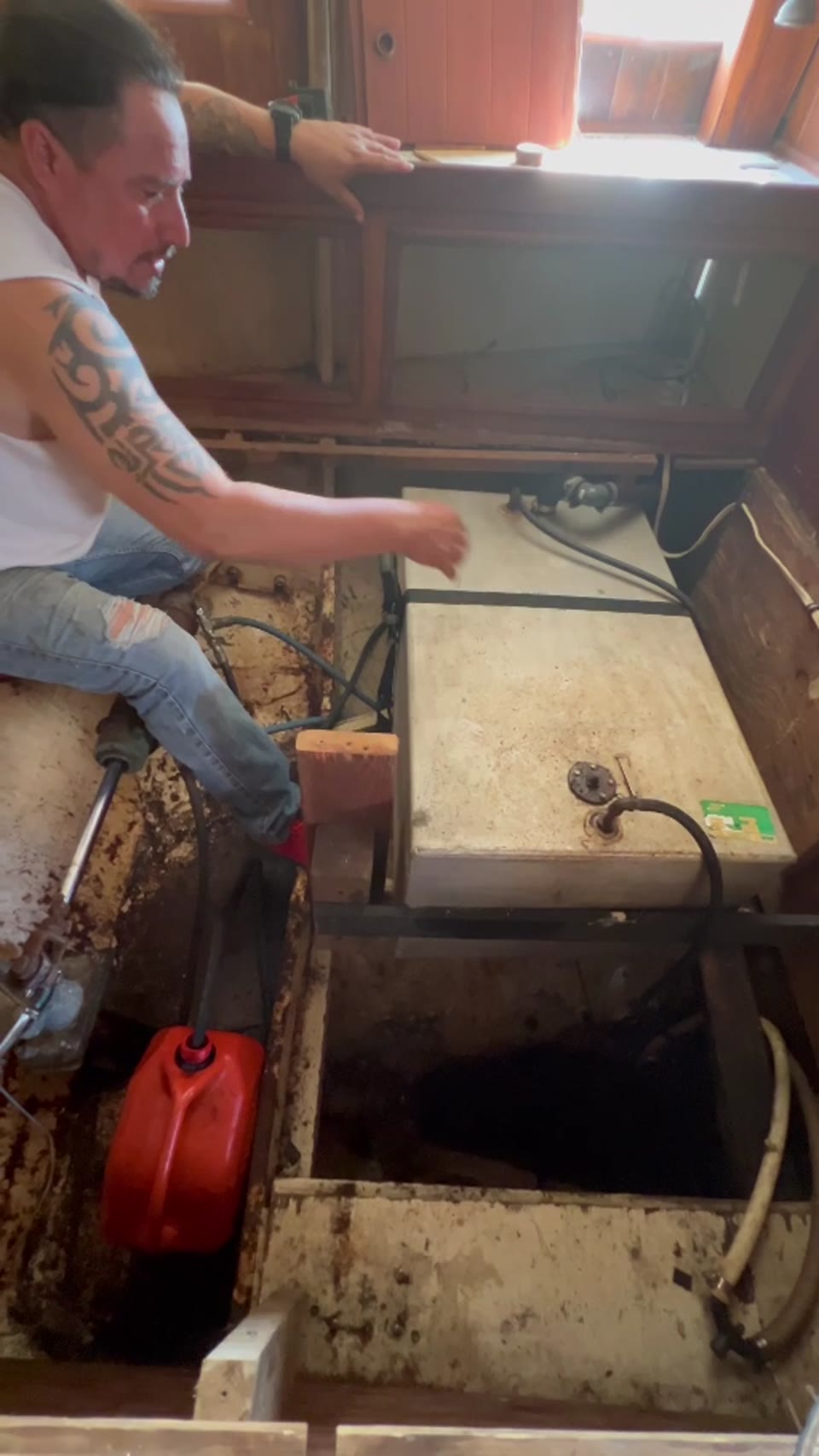
By that point, we knew this wasn’t a small repair. The damage extended from the aft captain’s quarters through much of the living space, as far forward as the cabin across from the galley. Roughly two-thirds of the interior needed rebuilding.
Knowing the extent was one thing. Starting to remove it was another.
We made jokes about Tortuga going into the operating room. She was our patient, and we were keeping her on life support while we removed the things that were making her sick.
We talked about the rot and termite damage as her cancer. The water intrusion and years of neglect had left us with something we couldn’t cover up and hope would improve. The damaged wood had to come out.
The joking didn’t mean we thought the situation was small. It was how we talked about doing something so extensive to a boat we were trying to save.
We weren’t taking her apart because we had given up on her.
We were taking her apart because we hadn’t.
And underneath all of that work was a thought I kept coming back to: I hoped we could rebuild her better than she had been.
I wanted that to be true. But wanting it and knowing how to accomplish it were not the same thing.
Fabian was a skilled carpenter, from a long line of carpenters. He brought knowledge to this project that I did not have.
I am a journeyman lineman. I build power lines and transmission lines. I have a trade, and I understand the work that belongs to it. But building boats was not my trade. Rebuilding cabinets, bunks, and an entire wooden interior was outside my own skills.
That mattered.
It would be easy to tell this story afterward as though determination was the only qualification I needed. It wasn’t. I needed someone who understood the work I didn’t, and Fabian’s carpentry skills were an important part of why I believed we could move forward.
I had faith that I had the right people.
I also had faith that I would find the materials.
That second part was still a very large unanswered question.
At the time, I had no supply chain. I hadn’t established the suppliers we would need to support a rebuild of this size. There wasn’t a nearby marine supplier I could turn to for the materials and paint we needed. The nearest boat chandlery I knew of was in Vallarta, about three hours away.
We were beginning work that would require a great deal of material, without having that material supply figured out.
There is a practical difference between deciding what you want to build and knowing where you can get what you need to build it. I was committed to the first while still trying to solve the second.
The project needed both.
Faith wasn’t going to supply the wood. It wasn’t going to put the right paint nearby, or give me Fabian’s experience with carpentry. Those needs remained, whether I felt confident that morning or not.
And yet my confidence was remarkably steady.
Looking back, that may have been to my detriment.
I don’t remember my faith wavering nearly as much as the circumstances probably justified. My belief in the dream, and in our ability to make it happen, overshadowed the things I was missing.
My lack of boatbuilding skills.
My lack of materials.
My lack of an established supply chain.
Those weren’t small details. They were parts of the job that still needed answers, and they probably should have held me back more than they did.
That is something I want to be honest about when I tell this story. I believed we could do it, but my belief was not proof that I was prepared.
I had enough confidence to move forward. I did not yet have everything necessary to make moving forward straightforward.
Both things were true.
My family’s faith in me mattered. So did my faith in Fabian, and in the possibility of finding what we needed. But none of that removed my responsibility to deal with the practical problems in front of us.
There was still damaged wood to remove. There were still decisions to make about what would take its place. There were materials to locate and parts of the work I would have to rely on someone else to do well.
The dream had brought me to this point. Now it was asking more of me than enthusiasm.
It was asking me to recognize what I knew, admit what I didn’t, and keep working on the difference.
We had documented the interior because some of Tortuga’s past was worth preserving. We had begun taking it apart because too much of the wood could no longer stay.
And I had chosen to rebuild her without having every answer in hand.
That was the reality of our beginning. Not a complete plan carried out without hesitation, and not a man who already knew how to do everything the boat required.
A skilled carpenter. A journeyman lineman. A boat with far more damage than we had expected.
And my unwavering belief that we could give her another life, even as I was beginning to understand how much that belief still required of us.
The part you don’t picture
When you imagine following a dream, you tend to give the best parts the most attention.
I could imagine the family aboard and the places we might go. I wasn’t spending nearly as much time imagining how I would feel when we found termites.
Yet that discovery belonged to the same story.
Following a dream matters to me. So does being honest about what it asks of you. It isn’t necessarily going to unfold easily, or in the order you pictured. There will be problems you didn’t anticipate, including some that change the size of the job.
That doesn’t make the disappointment any less real. You can believe in what you’re doing and still feel that punch in the gut.
What matters next is how you deal with the problem.
For me, the goal is to accomplish two things: solve what is wrong now and, where possible, reduce the chance of another problem later.
The second part isn’t guaranteed. But it is worth thinking about while you are doing the first. Once you have uncovered something that needs attention, there is an opportunity to understand it rather than simply get it out of sight.
That is the approach I want to take with Tortuga. Not pretending we can make her problem-free, but making thoughtful decisions about the problems we do find.
Still the same dream
Finding termites wasn’t an inspiring moment. It was a hard one. I don’t need to turn it into something pleasant to make it part of our story.
What came afterward mattered: deciding that I still wanted to do this, and accepting that the work was going to be part of getting there.
I still wanted those experiences with my family. I still wanted to find out what life aboard Tortuga could become.
We weren’t sailing toward Patagonia yet.
We were working on the boat that might one day take us there.
And that work belonged to the journey, too.